Home > Fees & Getting Started > How Out-of-Network Reimbursement Works
How Out-of-Network Reimbursement Works for Psychiatry and Therapy
By Ryan S. Sultan, MD, Assistant Professor of Clinical Psychiatry, Columbia University Irving Medical Center
Published · Last reviewed
The short answer. Your plan pays you back a share of its own allowed amount for each service code, after any deductible you still owe. Everything the clinician charges above that allowed amount stays with you.
Plan pays you = (allowed amount − deductible still owed) × (100% − your coinsurance)
Your net cost  = fee − plan payment
After the out-of-pocket maximum: plan pays 100% of the allowed amount
In 249 processed out-of-network service lines from an NYC outpatient psychiatry practice (2019–2026, de-identified), plans paid a median 80% of the allowed amount on lines with no deductible, and nothing on 49 of the 56 lines where a deductible applied.
Most people find out how out-of-network coverage works from their first Explanation of Benefits, which is the most expensive way to learn it. This guide teaches the arithmetic with a normalized $100 bill, walks a full plan year from deductible to out-of-pocket maximum, and then shows eight real, redacted insurer remittances with what happened on each one. The calculator runs your own numbers without asking who you are.
The formula, step by step
Four numbers decide every out-of-network payment: the allowed amount, the deductible you still owe, your coinsurance, and the out-of-pocket maximum. The allowed amount is the maximum your plan will pay for a covered service, and your out-of-network coinsurance is the percentage of that allowed amount you pay.
Take a visit billed at a normalized $100. Suppose the plan allows $80 for that service code, your deductible is already met, and your coinsurance is 30%.
- Start from the allowed amount, $80. The other $20 is the gap between the bill and the allowed amount. The plan never reimburses it, and it never counts toward your deductible or out-of-pocket maximum.
- Subtract any deductible you still owe. Here, none. Early in the year, this step can swallow the whole $80.
- Apply your coinsurance. You owe 30% of $80, which is $24. The plan pays the other 70%: $56.
- Net it out. You paid $100 and got $56 back, so the visit cost you $44. Your plan's "70% coverage" returned 56% of the bill.
- Check the cap. Once your deductible and coinsurance reach the out-of-pocket maximum, the plan pays 100% of the allowed amount, $80 back per visit. The $20 gap continues.
Every step uses the plan's allowed amount. That is why the same "70% coverage" can return most of one person's bill and a small fraction of another's.
A plan year, visit by visit
One visit tells you little. Reimbursement changes through the year because the deductible and out-of-pocket maximum are running balances. Here is one plan year of 40 visits, each billed at a normalized $100, with an $80 allowed amount, $400 of deductible left, 30% coinsurance and a $700 out-of-network out-of-pocket maximum that includes the deductible.
| Phase | Visits | Back from the plan, per visit | Your net, per visit | What is happening |
|---|---|---|---|---|
| 1. Deductible | 1–5 | $0 | $100 | Each $80 allowed amount goes to the deductible until $400 is used up. |
| 2. Coinsurance | 6–17 | $56 | $44 | You pay 30% of $80 ($24); the plan pays $56. |
| Crossing the cap | 18 | $68 | $32 | Only $12 of coinsurance was left before the $700 maximum. |
| 3. Out-of-pocket max met | 19–40 | $80 | $20 | The plan pays 100% of the allowed amount. The $20 gap continues. |
| Year | 40 | $2,500 total | $1,500 total | 62.5% of what you paid came back. |
Three things follow. The first visits of a year often return nothing, which is the deductible doing its job. Starting care in January and starting in October can produce very different years, since deductibles reset with the plan year. And a heavy-treatment year can end with most of each allowed amount coming back. The out-of-pocket limit doesn't include costs above the allowed amount, and the CMS sample Summary of Benefits and Coverage shows separate out-of-pocket limits for network and out-of-network care, with balance-billed charges outside both.
Calculator: your numbers, your year
Enter what your plan told you. If you only know part of it, leave the fee at 100 and treat the results as percentages.
Estimates only. Your plan's documents and remittances decide the real payment, including whether a service is covered, how many units it allows, and whether a visit's two lines are processed separately.
How your plan sets the allowed amount
Every plan picks a benchmark, and the benchmark decides your reimbursement more than the percentage on your card. Plans describe it in their benefit documents, and the remittances above sometimes name it.
| Method | How it works | Verified example |
|---|---|---|
| Percentage of Medicare | The plan pays a multiple of the Medicare rate for the same code in your area. | The NYSHIP Empire Plan sets non-network allowed amounts at 275% of Medicare rates and pays 80% after the deductible (2026 At A Glance). UnitedHealthcare lists a percentage of CMS rates among its benchmarks (UHC disclosure). |
| FAIR Health benchmark | A percentile of what clinicians in your area bill or are allowed, from an independent claims database. | UnitedHealthcare lists FAIR Health's database among its benchmarks (UHC disclosure). |
| The plan's own maximum | A proprietary schedule. The remittance tells you the result, and the plan's documents describe the method. | Anthem remittances in this dataset describe an "out-of-network maximum amount" with the remaining balance billable to the member; UnitedHealthcare's cite a "database of competitive fees in your area." |
| Fixed plan allowance | A set dollar allowance per service. You pay the difference between the allowance and the fee. | New York City's NYCE PPO: with a non-contracted clinician, you pay the difference between the plan allowance and the fee (NYCE PPO benefit summary). |
Why FAIR Health exists. FAIR Health was established in October 2009 as part of the settlement of a New York State investigation into conflicts of interest in how claims were adjudicated (FAIR Health). Its consumer site lets you look up typical charges and out-of-network allowed amounts for a code in your ZIP code, which is the closest thing to a public estimate when your plan won't quote one.
Medicare multiples are checkable. Medicare rates are public. Look up each code on your claim for your locality in the CMS Physician Fee Schedule look-up, add the lines, and multiply by your plan's percentage. The calculator's "% of Medicare" option does the rest.
Coinsurance decoder
"What does 50% coinsurance out of network mean" is one of the most common questions people search. On every row below, the percentage applies to the allowed amount after the deductible.
| Your out-of-network coinsurance | You pay | Plan pays you | Note |
|---|---|---|---|
| 0% | $0 | $100 | Usually means the out-of-pocket maximum is met, or the plan pays in full |
| 10% | $10 | $90 | |
| 20% | $20 | $80 | The most common out-of-network split in this dataset |
| 30% | $30 | $70 | “70% out-of-network coverage” means this row |
| 40% | $40 | $60 | |
| 50% | $50 | $50 | |
| 100% | $100 | $0 | No out-of-network benefit in practice; everything is yours |
Eight real remittances, explained
These are payer-to-practice remittances from the de-identified dataset described below. They carry the same numbers a patient's Explanation of Benefits does (allowed amount, deductible, coinsurance and payment) in a different layout. Every patient identifier and every dollar amount has been blacked out, so read them for the codes and the pattern. Each caption explains what happened.
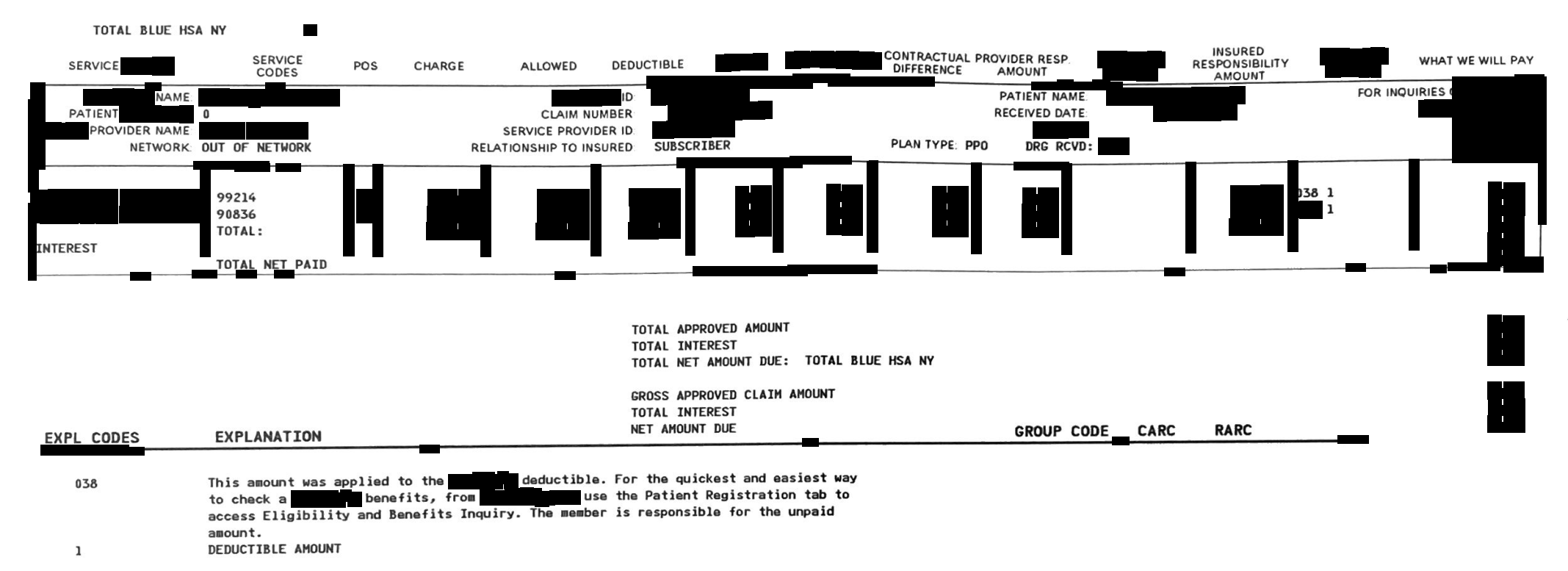
Codes: 038 (Anthem: applied to deductible) · CARC 1 (Deductible Amount)
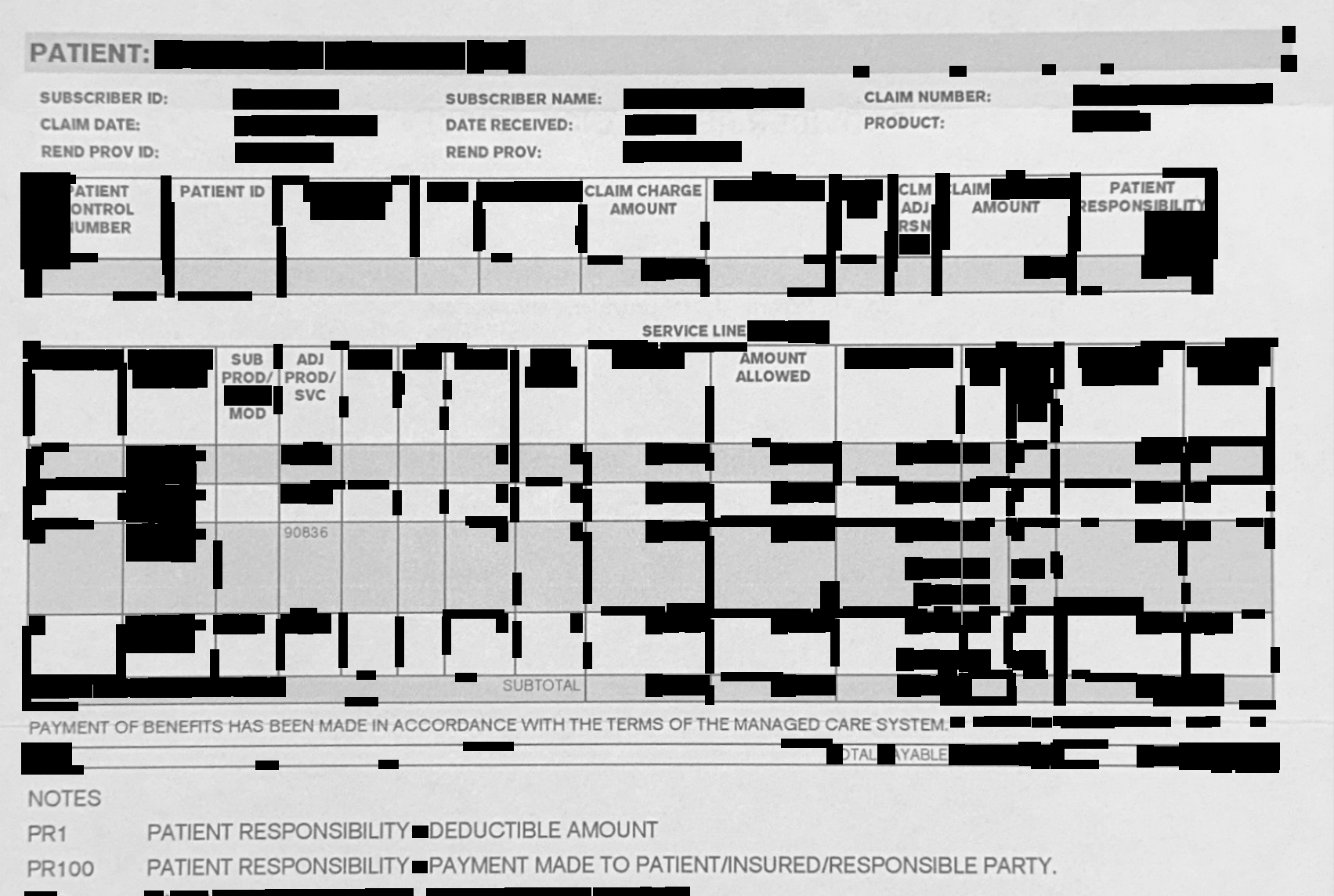
Codes: PR1 (Deductible Amount) · PR100 (Payment made to patient/insured/responsible party)
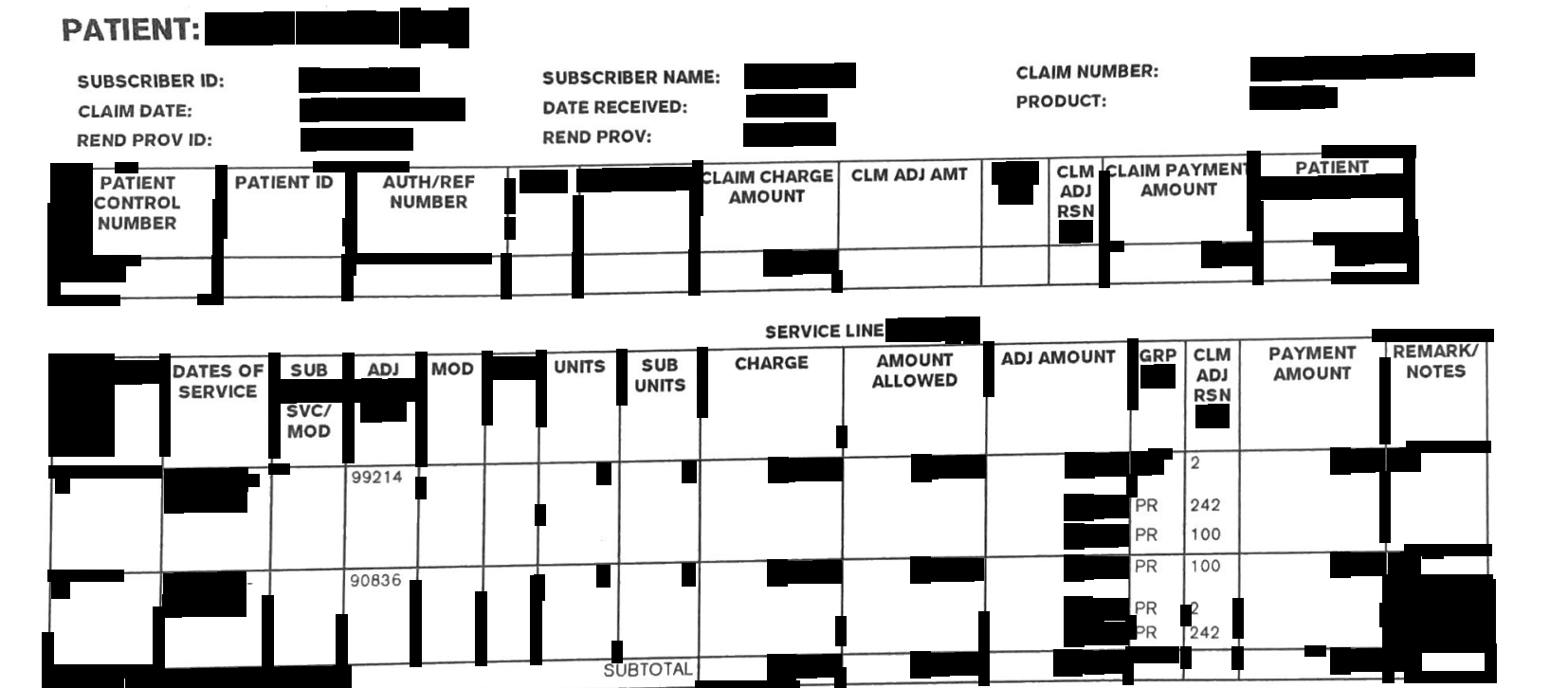
Codes: PR2 (Coinsurance Amount) · PR100 (Payment to patient) · PR242 (Services not provided by network/primary care) · ND (UHC: Medicare-based allowed)
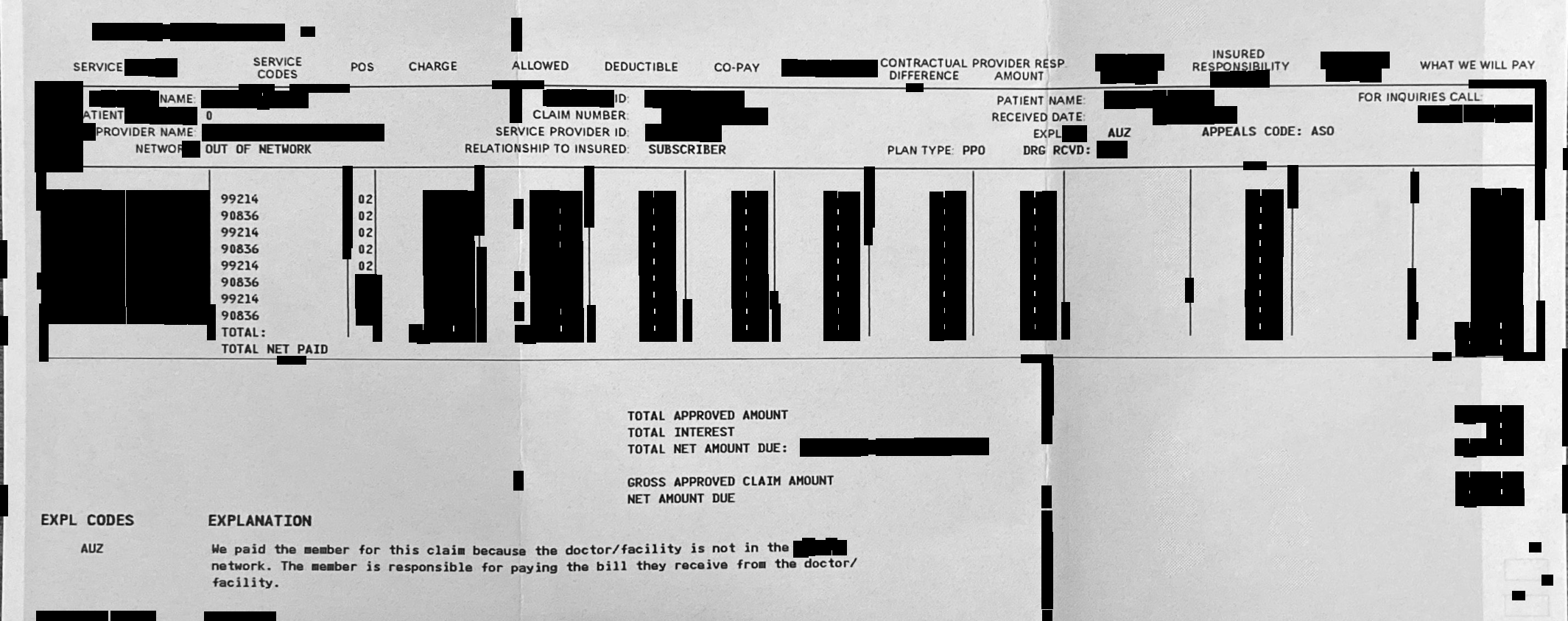
Codes: AUZ (Anthem: paid to member, out-of-network) · Appeals code ASO
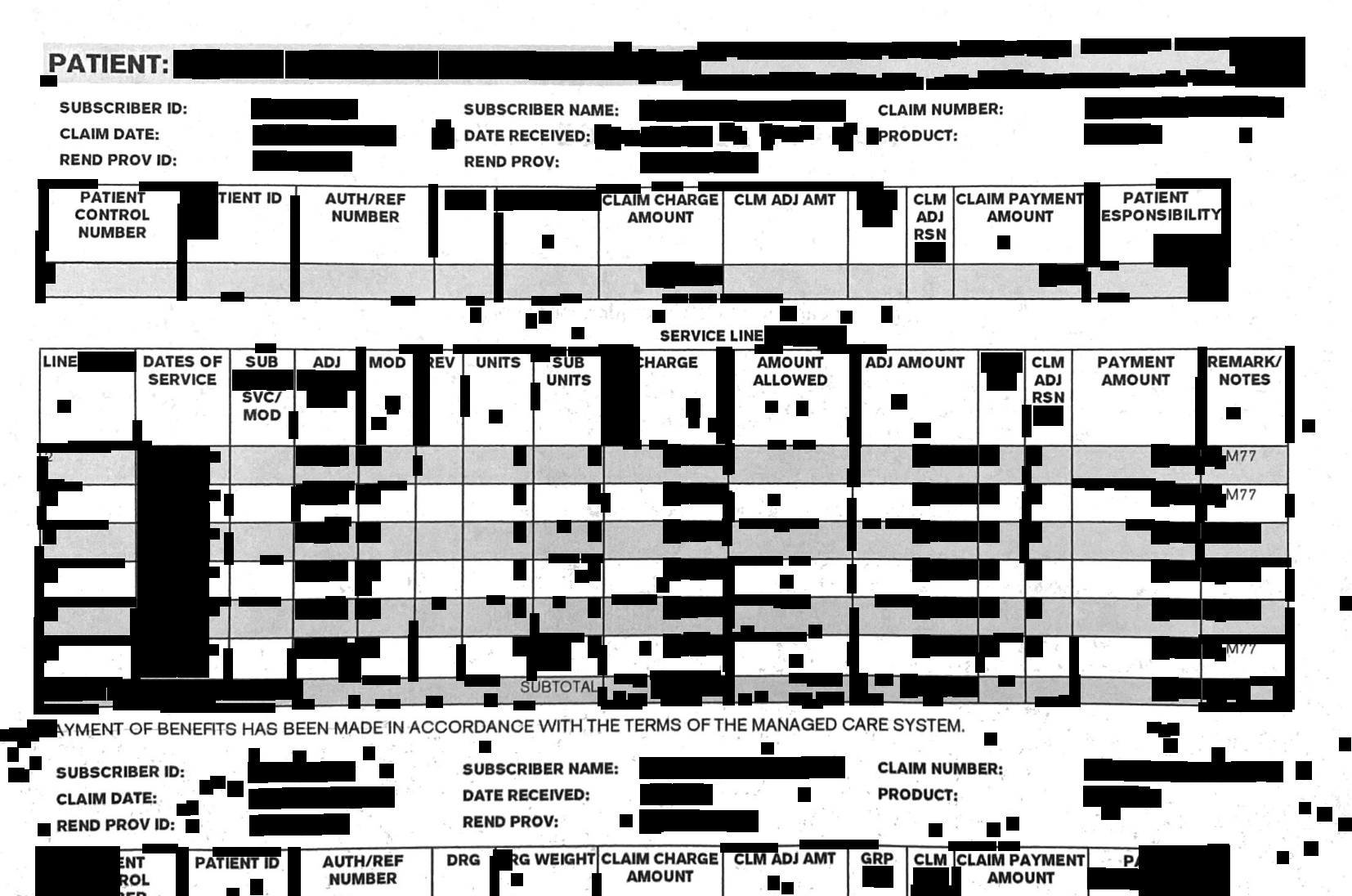
Codes: M77 (Missing/incomplete/invalid/inappropriate place of service)
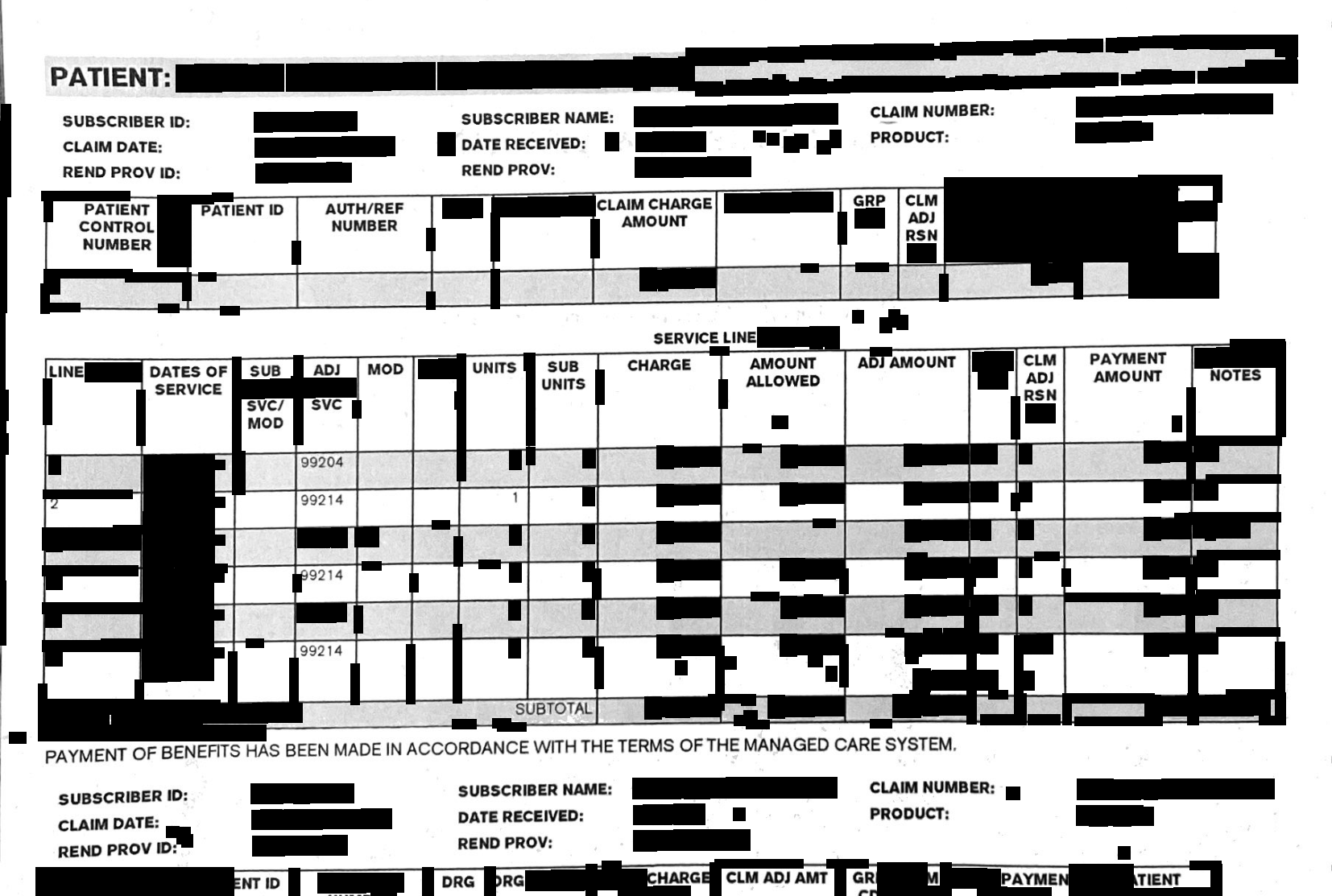
Codes: PR1 (Deductible Amount) on the early lines, then coinsurance
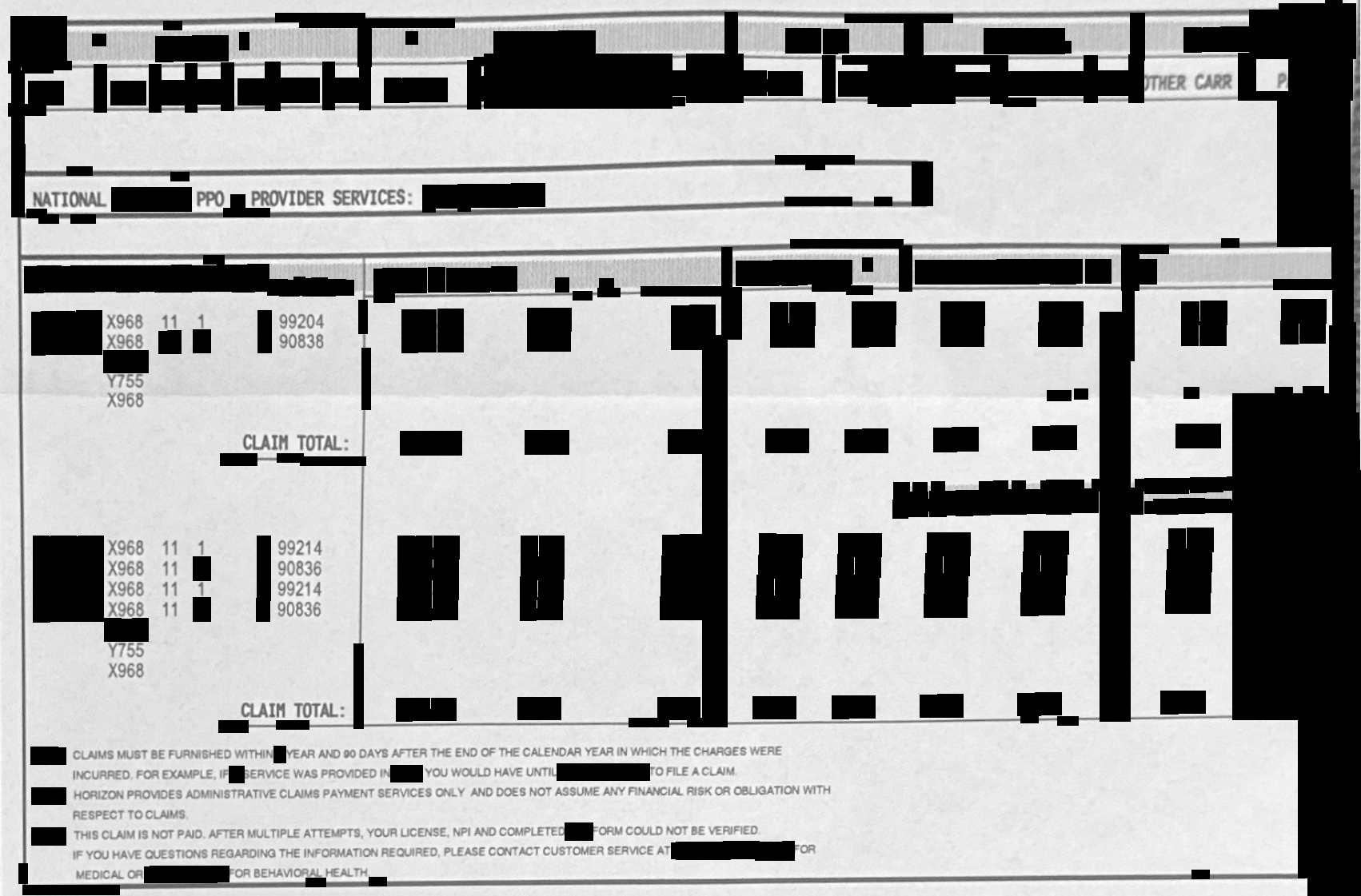
Codes: X968 (Horizon: license/NPI/tax form not verified) · Y755 · Z632 (filing-deadline note)
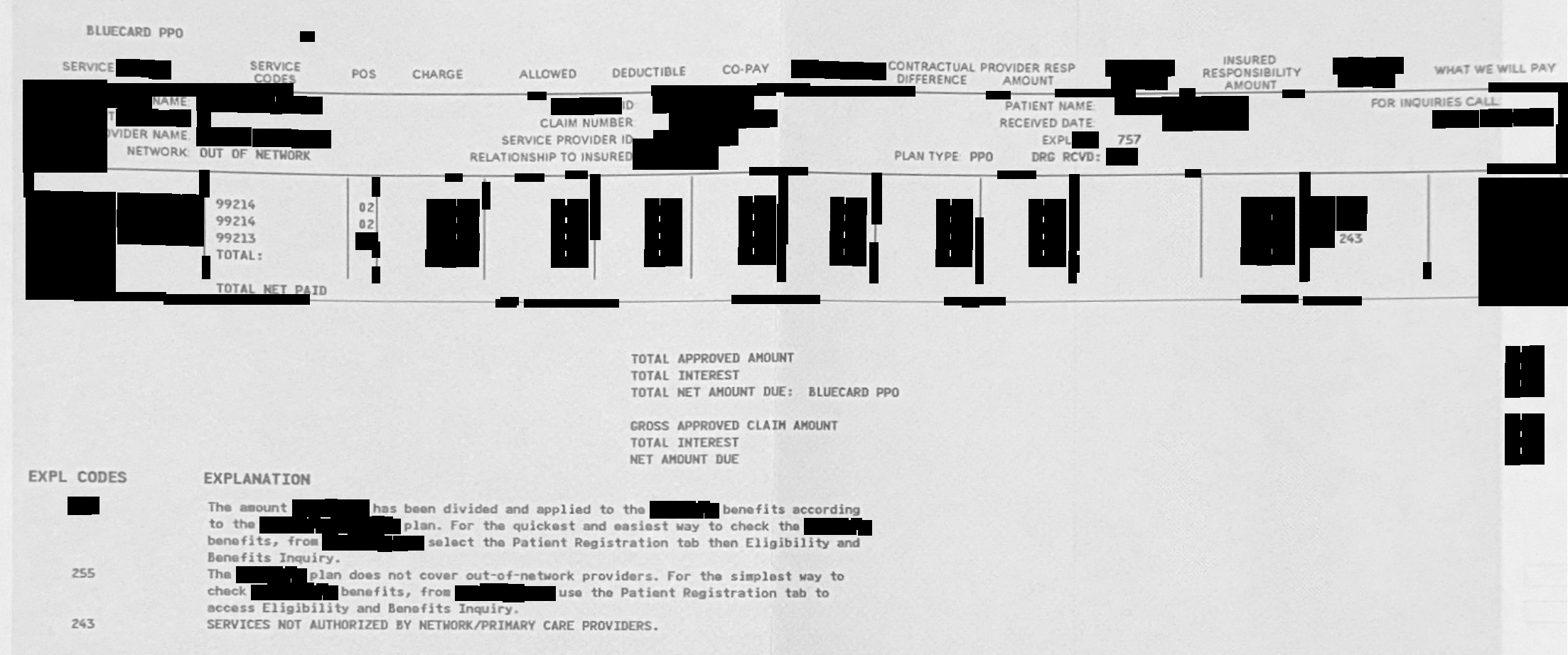
Codes: 255 (Anthem: plan does not cover out-of-network) · 243 (Services not authorized by network/primary care)
Reason codes beginning with PR are X12 "patient responsibility" adjustments; the numbers after them come from the X12 Claim Adjustment Reason Code list, and M77 from the X12 Remittance Advice Remark Codes. Three-character codes such as 038, AUZ and X968 are the payer's own and are explained on the remittance itself.
What 265 out-of-network claim lines actually paid
These are real claims from an NYC outpatient psychiatry practice, 2019–2026, de-identified: 265 service lines from 29 patients, billed out of network to Anthem BCBS (160 lines), UnitedHealthcare (85), Horizon BCBS (12) and Independence Blue Cross (8). Most visits were with nurse practitioners and therapists. 249 lines were processed and 16 were denied, 6 of them for a credentialing hold at one payer.
- A deductible was applied on 56 of 249 processed lines (22%). On 49 of those 56, the plan paid nothing on the line.
- On the 193 lines with no deductible, plans paid a median 80% of the allowed amount (middle half: 70% to 90%).
- The most common member coinsurance was 20%, followed by 40% and 30%.
| Payer | Code | Lines (n) | Plan paid ÷ allowed, median (IQR) | Member coinsurance, median | Lines with deductible applied | Lines denied |
|---|---|---|---|---|---|---|
| Anthem BCBS | 90833 | 12 | 50% (37.5-62.5%) | 40% | 25% | 0% |
| Anthem BCBS | 90836 | 57 | 80% (70-80%) | 20% | 18% | 0% |
| Anthem BCBS | 99213 | 11 | 50% (35-60%) | 50% | 27% | 0% |
| Anthem BCBS | 99214 | 59 | 80% (70-90%) | 20% | 12% | 2% |
| UnitedHealthcare | 90833 | 9 | 70% (70-80%) | 30% | 11% | 0% |
| UnitedHealthcare | 90836 | 31 | 60% (0-70%) | 30% | 38% | 6% |
| UnitedHealthcare | 99213 | 11 | 70% (70-75%) | 30% | 9% | 0% |
| UnitedHealthcare | 99214 | 26 | 60% (0-67.5%) | 40% | 35% | 0% |
How to read this. Cells require at least three distinct patients; every Horizon and Independence Blue Cross cell, and every code below that threshold, is suppressed. Medians include lines where a deductible applied, which pull them down. The practice bills a medication visit as an evaluation-and-management line plus a psychotherapy add-on line, and splits its charge across the two, so allowed-to-billed ratios mostly reflect that split and are left out. These are 29 people's claims with a mix of employers and plan designs; treat them as real examples of how the arithmetic plays out, and use your own plan's numbers for your own decision. A machine-readable copy of this table is at /data/oon-claims-summary-2026.json.
| Coinsurance | Lines |
|---|---|
| 0% | 39 |
| 10% | 17 |
| 20% | 61 |
| 30% | 36 |
| 40% | 38 |
| 50% | 9 |
Psychiatry codes on your claim
Therapy claims usually carry one code per visit. A psychiatry visit that combines medication management and psychotherapy carries two: an evaluation-and-management code plus a psychotherapy add-on. The plan processes each line on its own, which is why one visit can show a deductible on the first line and coinsurance on the second.
| Code | CMS short descriptor | Where you'll see it |
|---|---|---|
| 90792 | Psych diag eval w/med srvcs | A psychiatric diagnostic evaluation that includes medical services |
| 99204 | Office o/p new mod 45 min | A new-patient visit billed as evaluation and management |
| 99214 | Office o/p est mod 30 min | The most common medication-management follow-up |
| +90833 / +90836 / +90838 | Psytx w pt w e/m 30 / 45 / 60 min | Psychotherapy added to the same visit |
| 90834 / 90837 | Psytx w pt 45 / 60 minutes | A therapy-only session |
Descriptors from the CMS 2026 Physician Fee Schedule data. The full guide to these codes, including what each looked like in the dataset, is on the psychiatry billing codes page.
Integrative Psych sees patients in New York, Florida, Montana, New Jersey and Connecticut. Your location appears to be outside those states, so here are options closer to you.
See a psychiatrist at Integrative Psych
Integrative Psych is out-of-network with every insurer. The practice gives you a superbill for each visit so you can file for reimbursement, and new patients are often seen in as little as 5–7 days.
Find a clinician near you
Search psychiatrists, therapists and psychiatric nurse practitioners by ZIP code and specialty. The reimbursement math on this page works the same with any out-of-network clinician.
Use your insurance
Leave your state, ZIP code and insurance plan, and Frontier Mental Health will follow up as in-network options open. Frontier isn't accepting insurance patients yet; the form holds your place.
How to call your insurer
Call the member services number on your card, say you are asking about out-of-network outpatient mental health benefits, and work through this script. Behavioral health is often run by a separate company from your medical plan, so say "mental health" early.
- "Does my plan include out-of-network outpatient mental health benefits?" If the answer is no, stop; a superbill won't change it.
- "What is my out-of-network deductible, and how much have I met this plan year?"
- "After the deductible, what coinsurance do I pay out of network?"
- "What is the allowed amount for CPT codes [your codes, e.g. 90792, 99214 and 90836] in ZIP code [the clinician's ZIP]? How is it determined: a percentage of Medicare, a FAIR Health percentile, or a fee schedule?"
- "What is my out-of-network out-of-pocket maximum, and does the deductible count toward it?"
- "Is preauthorization required for outpatient psychiatry or therapy?"
- "What is the deadline to submit an out-of-network claim, and where do I send it?"
- "Is telehealth paid the same as in-person, and is there a place-of-service or modifier requirement?"
Before you hang up, write down the representative's name and a call reference number. The full question-by-question guide is on the out-of-network benefits call page.
Superbill checklist
A superbill is the itemized receipt your clinician gives you to file with the plan. Before you submit it, check that it has:
- Your name, date of birth and address, as they appear on your insurance card
- Your member ID (and the subscriber's name if you're a dependent)
- The clinician's name, credentials, NPI, license number and tax ID
- The practice address and place-of-service code (telehealth codes matter; see the denial above)
- Each date of service, with every CPT code on its own line, including add-on codes
- A diagnosis code for each line
- The charge per line and the amount you paid
- The clinician's signature or attestation
Submit through your plan's member portal or claim form, keep a copy, and match each line to the remittance that comes back. The superbill guide covers the rest.
Denials and appeals: what a fixed denial looks like
The two UnitedHealthcare scans above are the same visits. The first remittance denied every telehealth line with remark M77 (place of service). After the claim was corrected and resubmitted, the second remittance processed the lines normally: deductible first, then coinsurance. That is the usual shape of an administrative denial. The fix is a corrected claim; arguing about medical necessity would have been the wrong move.
Sort denials into three kinds before acting:
- Fixable paperwork. Place of service, a missing modifier, an unverified NPI or tax form (the Horizon scan). Ask the practice for a corrected superbill or claim and resubmit.
- No benefit. The plan has no out-of-network coverage (the Anthem BlueCard scan). Only a network-adequacy referral or a different plan changes this.
- Coverage decisions. Medical necessity or a plan exclusion. These go through appeal. For most plans you have 180 days after a denial notice to file an internal appeal, and after a final denial you can request an external review within 4 months; the plan must accept the external reviewer's decision.
In New York, ask about network adequacy when you can't find an in-network psychiatrist. New York Insurance Law §4804 says that when an insurer offering a managed care product determines it has no in-network clinician with appropriate training and experience for your needs, it must refer you to a non-participating one at no additional cost beyond what you would pay in network. Ask for the referral, and the reason for any refusal, in writing.
Traps that cost people money
- A plan with no out-of-network benefit. The Anthem BlueCard scan above reads PPO and still denied every line for that reason. HMO and EPO plans generally cover only in-network care outside emergencies.
- Medicare and opted-out psychiatrists. Medicare won't pay for services from a clinician who has opted out, except in emergencies, and an opted-out physician can't submit Medicare claims (Medicare.gov; 42 CFR 405.425).
- The gap above the allowed amount. Balance billing is the difference between the clinician's charge and the allowed amount; it never counts toward your out-of-pocket maximum.
- Thinking the No Surprises Act covers this. Its billing protections cover emergency care, certain non-emergency care at in-network hospitals and surgery centers, and air ambulances (CMS). An office visit you choose with an out-of-network psychiatrist falls outside them. If you pay without insurance, you can usually get a good faith estimate and dispute a bill that runs at least $400 over it.
- Filing deadlines. Plans print them on remittances (the Horizon scan has one). Late claims can be refused regardless of coverage.
- Two-line visits. A psychotherapy add-on code rides on the evaluation-and-management line. One add-on line in this dataset was denied with the payer's explanation that an add-on is only considered when the primary procedure is separately reimbursed.
Integrative Psych sees patients in New York, Florida, Montana, New Jersey and Connecticut. Your location appears to be outside those states, so here are options closer to you.
Out-of-network psychiatry at Integrative Psych
Integrative Psych is out-of-network with every insurer. The practice gives you a superbill for each visit so you can file for reimbursement, and new patients are often seen in as little as 5–7 days.
Find a clinician near you
Search psychiatrists, therapists and psychiatric nurse practitioners by ZIP code and specialty. The reimbursement math on this page works the same with any out-of-network clinician.
Use your insurance
Leave your state, ZIP code and insurance plan, and Frontier Mental Health will follow up as in-network options open. Frontier isn't accepting insurance patients yet; the form holds your place.
Related
What out-of-network psychiatric care costs in New York · The benefits call, question by question · Superbills explained · Psychiatry billing codes, explained for patients · Empire Plan (NYSHIP) out-of-network mental health · NYC PPO plan names decoded
Frequently asked questions
Mechanics
How does out-of-network reimbursement work?
You pay the clinician, submit a claim or superbill to your plan, and the plan pays you its share of its own allowed amount for each service code. Any deductible comes out first, then your coinsurance. The difference between the bill and the allowed amount stays with you.
Does insurance pay anything if my psychiatrist is out of network?
If your plan has an out-of-network benefit, yes. A PPO lets you use clinicians outside the network for an additional cost, while an HMO generally won't cover out-of-network care except in an emergency and an EPO covers only in-network care except in an emergency. The denial in the last scan above shows what a plan without the benefit looks like.
What is an example of out-of-network reimbursement?
On a normalized $100 bill with an $80 allowed amount, a met deductible and 30% coinsurance, the plan pays you $56 and your net cost is $44. The calculator on this page runs the same math with your own numbers.
How do I calculate my reimbursement?
Plan payment equals the allowed amount, minus any deductible you still owe, times the plan's share (100% minus your coinsurance). Once you reach your out-of-pocket maximum, the plan pays 100% of the allowed amount. Nothing above the allowed amount is reimbursed.
How long does out-of-network reimbursement take?
It varies by plan and by how clean the claim is. Administrative denials, like the place-of-service and credentialing examples above, add a full cycle of correction and resubmission, so check each remittance when it arrives.
What happens when a claim is denied as out of network?
Read the reason code first. A plan with no out-of-network benefit (as in the Anthem BlueCard scan) won't pay on a superbill. A coding or paperwork denial can usually be corrected and resubmitted. For most plans you have 180 days from a denial notice to file an internal appeal, and you can ask for an independent external review after that.
Can I get my plan to cover an out-of-network psychiatrist at in-network cost?
Sometimes. New York Insurance Law §4804 says that if an insurer offering a managed care product determines it has no in-network clinician with appropriate training and experience for your needs, it must refer you to one outside the network at no more than in-network cost. Ask your plan whether it applies to you and request the referral in writing.
Terms
What is an allowed amount?
The maximum amount a plan will pay for a covered service. Your out-of-network reimbursement is a percentage of this number, and it is often lower than the bill.
What is the difference between the allowed amount and the charged amount?
The charged amount is the clinician's bill. The allowed amount is what your plan decides the service is worth. When a clinician bills you the difference, that is balance billing, and it doesn't count toward your deductible or out-of-pocket maximum.
What does 80% of UCR mean?
UCR (usual, customary and reasonable) is a benchmark of what clinicians in an area charge for a service. 80% of UCR means the plan pays 80% of that benchmark after your deductible. Some plans also describe their benchmark as a percentile of FAIR Health data or a multiple of Medicare.
Does 30% coinsurance mean I pay 30% or 70%?
You pay 30% of the allowed amount and the plan pays 70%, after the deductible. Neither percentage applies to the full bill.
Why do I still pay coinsurance after meeting my deductible?
The deductible is the first phase. After it is met, you share each allowed amount with the plan at your coinsurance rate until you reach the out-of-pocket maximum, when the plan pays 100% of the allowed amount.
Is the out-of-network deductible separate from the in-network deductible?
It can be. Your Summary of Benefits and Coverage lists network and out-of-network costs in separate columns, and the CMS sample version shows separate out-of-pocket limits for each.
Do payments above the allowed amount count toward my out-of-pocket maximum?
No. Costs above the allowed amount don't count toward the out-of-pocket limit, so the gap between the bill and the allowed amount continues even after you reach your maximum.
Superbills and claims
Do insurance companies pay superbills?
A superbill is the itemized receipt you send with a claim. Plans with an out-of-network benefit pay against it once the codes, diagnosis, dates and clinician identifiers are complete. Plans without that benefit don't pay at all.
Will Medicare accept a superbill from a psychiatrist who opted out of Medicare?
No. Medicare won't pay for services from a clinician who has opted out, except in emergencies, and an opted-out physician is prohibited from submitting claims to Medicare. Patients sign a private contract and pay the clinician directly.
Can I use an HSA or FSA for out-of-network therapy or psychiatry?
Usually. HSA-qualified medical expenses are those that would generally qualify for the medical expense deduction, and IRS Publication 502 lists psychiatric care and psychologists. Check your own plan's rules for FSAs.
Money
Is out-of-network therapy or psychiatry worth it?
It depends on the year, not the visit. Run the calculator with your deductible, coinsurance, out-of-pocket maximum and expected number of visits. If the net cost works for you, the choice of clinician widens. If it doesn't, an in-network clinician is a reasonable answer.
Is $200 too much for therapy?
The price alone doesn't answer it. What matters is your net cost after reimbursement, which depends on your plan's allowed amount and where you are in your deductible. Put your own numbers into the calculator above before deciding.
Why are so many psychiatrists out of network?
In national survey data from 2009 to 2010, 55.3% of office-based psychiatrists accepted private insurance, compared with 88.7% of other specialists.
How much does an out-of-network psychiatrist cost?
Fees vary by clinician and visit type, so ask each practice directly and get a Good Faith Estimate if you are paying without insurance. The cost guide for New York linked below walks through what to ask.
Payers
How do Aetna, Cigna, UnitedHealthcare and BCBS set out-of-network allowed amounts?
Each plan's benefit document names its method. UnitedHealthcare discloses benchmarks that include a percentage of Medicare rates and FAIR Health data. The remittances above show UnitedHealthcare citing Medicare-based sources and Anthem citing its own out-of-network maximum. Call and ask which method your plan uses.
How much does BCBS or Anthem reimburse for out-of-network psychiatry?
In the de-identified claims on this page, Anthem paid a median 80% of its allowed amount on the most common psychiatry lines (99214 and 90836). Your result depends on your plan's coinsurance and deductible.
Does the NYSHIP Empire Plan cover out-of-network mental health?
Yes. The 2026 Empire Plan At A Glance sets the non-network allowed amount at 275% of Medicare rates for the same service in the area and pays 80% of it after the combined annual deductible.
Sources
Every source below was checked on October 27, 2026.
- HealthCare.gov glossary: Allowed amount
- HealthCare.gov glossary: Out-of-network coinsurance
- HealthCare.gov glossary: Deductible
- HealthCare.gov glossary: Out-of-pocket maximum/limit
- HealthCare.gov glossary: Balance billing
- HealthCare.gov glossary: UCR (usual, customary, and reasonable)
- CMS sample completed Summary of Benefits and Coverage
- UnitedHealthcare: Information on payment of out-of-network benefits
- FAIR Health: Mission and Origins
- FAIR Health Consumer cost lookup
- NYSHIP, 2026 Empire Plan At A Glance (PEF)
- NYCE PPO benefit summary
- New York Insurance Law §4804
- CMS: Medical bill rights (No Surprises Act)
- CMS: What is a good faith estimate?
- Medicare.gov: Medicare costs and clinicians who opt out
- 42 CFR 405.425, Effects of opting out of Medicare
- X12 Claim Adjustment Reason Codes
- X12 Remittance Advice Remark Codes
- HealthCare.gov: Internal appeals
- HealthCare.gov: External review
- CMS Physician Fee Schedule look-up
- CMS Physician Fee Schedule data, 2026 indicators (short descriptors)
- HealthCare.gov: Health insurance plan & network types
- IRS Publication 969 (HSAs and other tax-favored health plans)
- IRS Publication 502 (Medical and dental expenses)
- Bishop TF et al. Acceptance of insurance by psychiatrists. JAMA Psychiatry. 2014;71(2):176-181
Written and reviewed by Ryan S. Sultan, MD
Assistant Professor of Clinical Psychiatry, Columbia University Irving Medical Center
Board Certified, Adult Psychiatry (2015) and Child & Adolescent Psychiatry (2016), ABPN
NPI 1972893642 · Verify credentials
Practice: Integrative Psych, 80 Eighth Avenue, Chelsea, Manhattan, NY 10011
Last reviewed: October 27, 2026
Educational information only. Not medical, legal or insurance advice. Your plan documents control what your plan pays. Reading this page does not establish a physician–patient relationship.