Home → ADHD Resources → Medication Monitoring
|
ADHD medication monitoring means height and weight plotted on a growth chart, blood pressure and pulse at baseline and follow-ups, structured rating scales, and a visit schedule: the AACAP practice parameter says at least monthly until symptoms stabilize, then individualized; the AAP's earlier guideline put stable follow-up at every 3 to 6 months. Each class has its own checklist. And monitoring is where care actually fails: in 2023 the median state completed both recommended metabolic tests for only 35.2% of Medicaid kids with two or more antipsychotic prescriptions. |
ADHD Medication Monitoring: What Should Be Checked, and How Often
By Ryan S. Sultan, MD
Assistant Professor of Clinical Psychiatry, Columbia University Irving Medical Center
Double Board-Certified in Adult Psychiatry & Child/Adolescent Psychiatry
Published:
Monitoring is where prescribing quality actually fails. In 2023, the median state completed both recommended metabolic tests, glucose and cholesterol, for just 35.2% of Medicaid children with two or more antipsychotic prescriptions that year (CMS Child Core Set). That's the generous measure: any test, anytime in the year, counts.
A stricter standard looks worse. When researchers checked adherence to the full guideline schedule in Texas Medicaid data from 2010 to 2018, glucose monitoring came in at 6.5% and cholesterol monitoring at 0.8%. Less than one child in a hundred got the lab schedule the guideline says every child on these drugs should get.
The overprescribing debate asks whether kids get too much medication, and that debate is worth having. It's only part of the story, though. The question with a clear answer in the data is whether the medication kids are already taking is being watched. It usually isn't. If an airline skipped scheduled maintenance at those rates, the fleet would be grounded until the checks happened.
Here's what monitoring is supposed to look like, what the guidelines actually say, and how to tell whether your child is getting it.
The guidelines are clearer than the folklore around them
For stimulants, the AACAP practice parameter (published 2007, still the operative document for child psychiatry) is specific about the physical basics. Before starting: blood pressure, pulse, height, and weight, in the context of a physical exam. After starting: those same vitals tracked at follow-ups, with height and weight plotted serially on a growth chart. A single weight is a data point. Plotted over time, the same numbers show whether a child is drifting across percentile lines, which is what the monitoring exists to catch.
On visit frequency, the parameter says follow-up should happen at least monthly until symptoms have stabilized. After that, it deliberately doesn't name one number. The schedule is individualized to symptom severity, comorbidity, treatment response, and how much the child is struggling at home and school.
The "every 3 months" figure families hear traces to the American Academy of Pediatrics, whose earlier ADHD guideline suggested an office visit every 3 to 6 months once a child is stable. The current AAP guideline (2019) frames it differently but just as firmly: manage ADHD as a chronic condition. That's the same way we handle asthma, where a child on a daily inhaler still gets scheduled lung checks; a refill on autopilot for two years would strike any pediatrician as a lapse.
In my practice, a child being titrated gets seen monthly or more. A genuinely stable child gets seen about every three months, and never less than twice a year. Anything sparser amounts to dispensing.
Each medication class has its own checklist
Parents often assume monitoring is one generic thing. In practice, each class fails in its own way, so each class gets watched in its own way.
| Class | What gets watched | What the evidence says |
| Stimulants (methylphenidate, amphetamines) |
Height and weight on a growth chart; blood pressure and pulse at baseline and follow-ups; appetite; sleep; mood; tics | In the MTA follow-up (enrolled mid-1990s, followed to adulthood), the consistently medicated subgroup was associated with about 2.5 cm lower adult height. The subgroups were self-selected, so the data cannot establish causation; families still deserve the number. On tics: pooled placebo-controlled trials show new or worsening tics at the same rate on stimulant and placebo (2015 meta-analysis). Watch for them anyway; don't panic over them. |
| SSRIs (fluoxetine, sertraline, escitalopram) |
Activation, irritability, agitation; suicidal thoughts, watched most closely in the first weeks; sleep; response on a rating scale | Bridge's 2007 meta-analysis of 27 pediatric trials: one additional child helped for every 3 treated for anxiety (10 for depression), one harmed by the suicidality signal for every 143. Both numbers belong in the same sentence, and both justify early, frequent contact after starting. |
| Alpha-2 agonists (guanfacine, clonidine) |
Blood pressure and pulse; sedation, especially early and after dose increases; never stopped abruptly | These are blood-pressure drugs being used for ADHD. The monitoring is the same as it would be for the original indication: vitals at baseline and follow-ups, with a planned taper whenever the drug is stopped. |
| Antipsychotics (risperidone, aripiprazole, others) |
Weight at every visit; glucose and lipids on a defined lab schedule; sedation; abnormal movements | In the SATIETY cohort (2001–2007, published in JAMA 2009), Correll and colleagues found antipsychotic-naive youth gained 4.4 to 8.5 kg in about 11 weeks depending on the drug, versus 0.2 kg untreated. The metabolic risk is fast and measurable, which is exactly why the 35.2% and 0.8% monitoring numbers above should bother you. |
Notably, antipsychotics show up in ADHD care far more often than the label suggests. In our study of 187,563 commercially insured youths newly diagnosed with ADHD (2010–2015, published in JAMA Network Open in 2019), 2.6% filled an antipsychotic within a year of diagnosis, and nearly half of those had no prior stimulant trial of any kind. Those are the kids for whom the lab schedule matters most, and the kids least likely to get it.
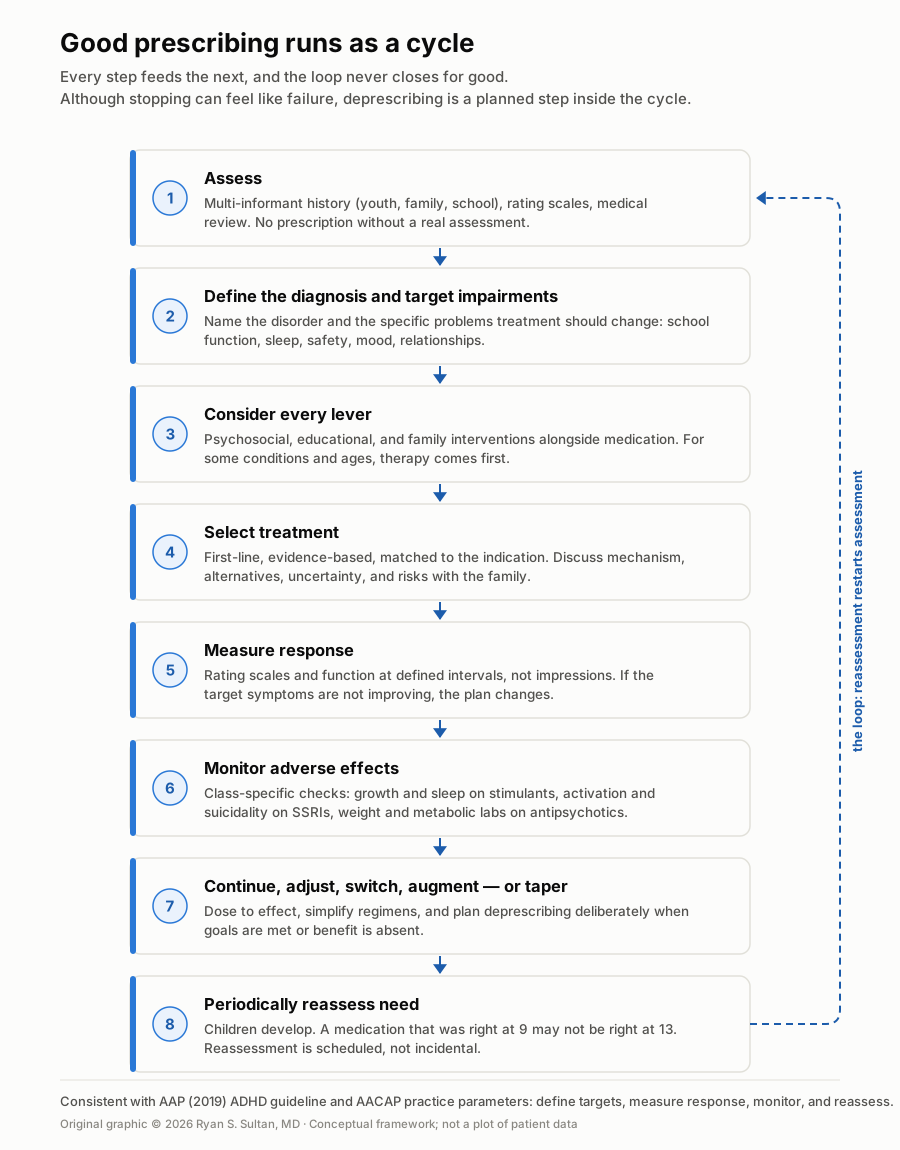
"How's he doing?" is where most follow-up visits stop
The most common follow-up visit in America goes like this. "How's he doing?" "Pretty good, I think." Refill sent. Ninety seconds.
That conversation has value, and I want prescribers having it. Measurement-based care asks for one step more: a structured rating scale, a Vanderbilt or an ADHD-RS, filled out by a parent and ideally a teacher, at defined intervals. Diabetes gets managed by measuring the blood sugar, and ADHD deserves the same standard. The scale asks the same 18-odd questions the diagnosis was built on, so this quarter's score can be compared directly with last quarter's.
Psychiatry has known about this gap for a long time. In survey data from 2006–2007, more than 80% of psychiatrists said they didn't routinely use outcome scales. That figure comes from adult psychiatry and it's old, but I've seen nothing since that suggests the habit reversed. The tools cost nothing. A Vanderbilt is two pages.
The same failure shows up wherever anyone has measured follow-up itself. Among Medicaid youth starting an antidepressant for depression (2016–2019), only about half met acute-phase follow-up standards, and about a quarter met continuation-phase standards. Half the kids starting one of the most scrutinized medication classes in pediatrics didn't get the early contact the quality standard requires.
And a note on the question parents ask me most at follow-ups: no, properly dosed medication shouldn't change who your child is. Flatness, joylessness, or "he's not himself" is a monitoring finding, usually a dose finding, and it's fixable. I wrote about that separately in does ADHD medication change personality.
Six questions to ask your child's prescriber
If you take one thing from this page, take these. A prescriber who welcomes them is giving your child careful treatment, whatever the medication count says.
- What exactly are we treating, and what should change, by when?
- What did we try, or rule out, before this medication?
- Is this use FDA-approved for kids, evidence-supported off-label, or neither?
- How will we measure whether it's working, not just feel it out?
- What are we monitoring for safety, and when are the labs or checks due?
- When do we sit down and re-decide whether my child still needs this?
Question six is the one nobody asks. Kids genuinely outgrow some conditions, and a medication that was right at nine may be wrong at thirteen. Reassessment has to be put on the calendar. Stopping well is its own clinical procedure with its own plan; I've laid that out in how to stop a child's psychiatric medication safely. And stopping badly happens at national scale without anyone deciding it: after the October 2022 Adderall shortage, children previously on Adderall were measurably more likely to end up on no stimulant at all, concentrated among kids on Medicaid (IQVIA data, 2020–2023). That story is in my post on the stimulant shortage and prior authorization.
The monitoring gaps at the top of this page highlight the importance of remaining vigilant at every follow-up: response measured on a rating scale, vitals and labs checked on schedule, and the need for the medication itself re-decided at set intervals.
Frequently asked questions
How often should a child on ADHD medication see the prescriber?
The AACAP practice parameter says at least monthly until symptoms have stabilized, then on an individualized schedule based on severity, comorbidity, and response. The AAP treats ADHD as a chronic condition requiring scheduled reassessment; its earlier guideline suggested a visit every 3 to 6 months once stable, which is where the every-3-months figure comes from. My own rule: monthly during titration, roughly quarterly when stable, and never less than twice a year.
Can ADHD medication cause tics?
The evidence is more reassuring than the package insert. Pooled placebo-controlled trials in children (a 2015 meta-analysis) found new or worsening tics at essentially the same rate on stimulants as on placebo. Tics wax and wane naturally in childhood, so a tic that appears after starting medication often reflects that natural course. If tics emerge, discuss dose and timing with the prescriber before any change is made; an abrupt stop is the one move to avoid. I've written more in ADHD with tics or Tourette syndrome.
What should be checked at ADHD medication follow-ups?
For stimulants: height and weight on a growth chart, blood pressure and pulse, structured questions about appetite, sleep, mood, and tics, and a rating scale from a parent and ideally a teacher. For SSRIs: activation and suicidal thoughts, most closely in the first weeks. For alpha-2 agonists: blood pressure, pulse, sedation. For antipsychotics: weight every visit, glucose and lipids on a lab schedule.
Does ADHD medication stunt growth?
The MTA follow-up (enrolled mid-1990s, followed into adulthood) found the consistently medicated subgroup was associated with about 2.5 cm lower adult height. Those subgroups were self-selected, so the data cannot establish causation. The trade-off is real, though, and families deserve to hear it stated plainly. It's also exactly why guidelines require serial growth-chart plotting: a child sliding across percentile lines should trigger a conversation about dose, drug holidays, or alternatives.
What should be checked at ADHD medication follow-up visits?
For stimulants: height and weight plotted on a growth chart, blood pressure and pulse, and structured questions about appetite, sleep, mood, and tics, plus a rating scale (such as a Vanderbilt or ADHD-RS) completed by a parent and ideally a teacher. For SSRIs: activation, irritability, and suicidal thoughts, watched most closely in the first weeks. For alpha-2 agonists like guanfacine and clonidine: blood pressure, pulse, and sedation. For antipsychotics: weight at every visit, and glucose and lipids on a lab schedule.
Further reading
- Are Kids Overmedicated?. The companion piece: what national prescribing data actually show, class by class.
- How to Stop a Child's Psychiatric Medication Safely. Stopping is a clinical procedure with its own plan.
- Complete ADHD Guide. Diagnosis, treatment, and lifespan management in one place.
- The ADHD Stimulant Shortage. What forced interruption does, and how to keep a prescription filled.
- Antipsychotics in ADHD. When they're evidence-supported, and the metabolic monitoring they require.
- Does ADHD Medication Change Personality?. What emotional blunting means and how it's fixed.
Work With Dr. Sultan
Dr. Ryan S. Sultan, MD evaluates and treats ADHD across the lifespan at Integrative Psych in Chelsea, Manhattan. Consultations cover diagnostic evaluation, second opinions, medication optimization with structured monitoring, and ongoing care.
This page is educational and isn't medical advice for any individual child. Never start, adjust, or stop a medication without a clinician who knows your child. If you or your child are in crisis, call or text 988.
Last Updated: August 6, 2026
Author: Ryan S. Sultan, MD | Columbia University Irving Medical Center