Home → Blog → How to Stop a Child's Psychiatric Medication Safely
|
There are no formal guidelines for stopping psychiatric medication in children. A 2026 systematic review screened 1,390 records published 2015-2025 and found zero. Stopping still requires a procedure of its own: when remitted depressed youth were randomized off fluoxetine, 69.2% relapsed within six months versus 42.0% who continued (Emslie 2008). A planned discontinuation needs sustained remission first, a taper matched to the drug's half-life, a relapse plan agreed in advance, low-stress timing, and scheduled follow-up. Never stop without the prescriber. |
How to Stop a Child's Psychiatric Medication Safely
By Ryan S. Sultan, MD
Assistant Professor of Clinical Psychiatry, Columbia University Irving Medical Center
Double Board-Certified in Adult Psychiatry & Child/Adolescent Psychiatry
Published:
|
Quick Answer: Medicine has never written the rules for stopping a child's psychiatric medication. A 2026 systematic review (Fargier et al., Basic Clin Pharmacol Toxicol) screened 1,390 records published 2015-2025 and found zero formal clinical practice guidelines on the subject. Stopping safely is still achievable, but the procedure has to be built deliberately. The elements: sustained remission first (for depression, the randomized evidence supports at least six months of continuation past remission; Emslie 2008 found 69.2% relapse on placebo vs 42.0% on continued fluoxetine in youth ages 7-18); a taper matched to the drug's half-life (short-half-life SSRIs produce the worst withdrawal; fluoxetine self-tapers; Stimpfl 2025); a relapse plan agreed before the first dose reduction; timing in a low-stress window, never before finals; and follow-up visits scheduled through and after the taper. A planned discontinuation has an assessment, a taper, and a follow-up plan; shortage-forced stops, insurance denials, and quiet quitting lack all three. Have this conversation with the prescriber, at an appointment, before any dose changes. |
Zero Guidelines Exist for Stopping a Child's Psychotropic Medication
In 2026, a French and UK research team screened 1,390 records published between 2015 and 2025, across five databases plus grey literature, searching for any formal clinical practice guideline on stopping psychotropic medications in children and adolescents (Fargier et al., 2026). They found zero.
The training pipeline is just as empty. A 2025 scoping review of deprescribing education found 46 published curricula in all of medicine, covering the literature through 2024. Every single one targets the care of older adults (Chow et al., 2025). Further, the word "deprescribing" appears zero times in the ACGME program requirements for pediatrics, psychiatry, and child and adolescent psychiatry, the documents that define what American residents must learn (current versions, verified 2026).
Pilots are certified on landings as well as takeoffs, and surgeons are trained to close as well as to cut. In pediatric psychopharmacology, every decision to start is made against a guideline, while every decision to stop is made against nothing. I prescribe these medications for a living, and I think the asymmetry is indefensible.
I've written elsewhere about why the "overmedicated kids" framing gets the data wrong. This page is the other half of that argument. If we're going to defend appropriate prescribing, we also have to know how to end it well.
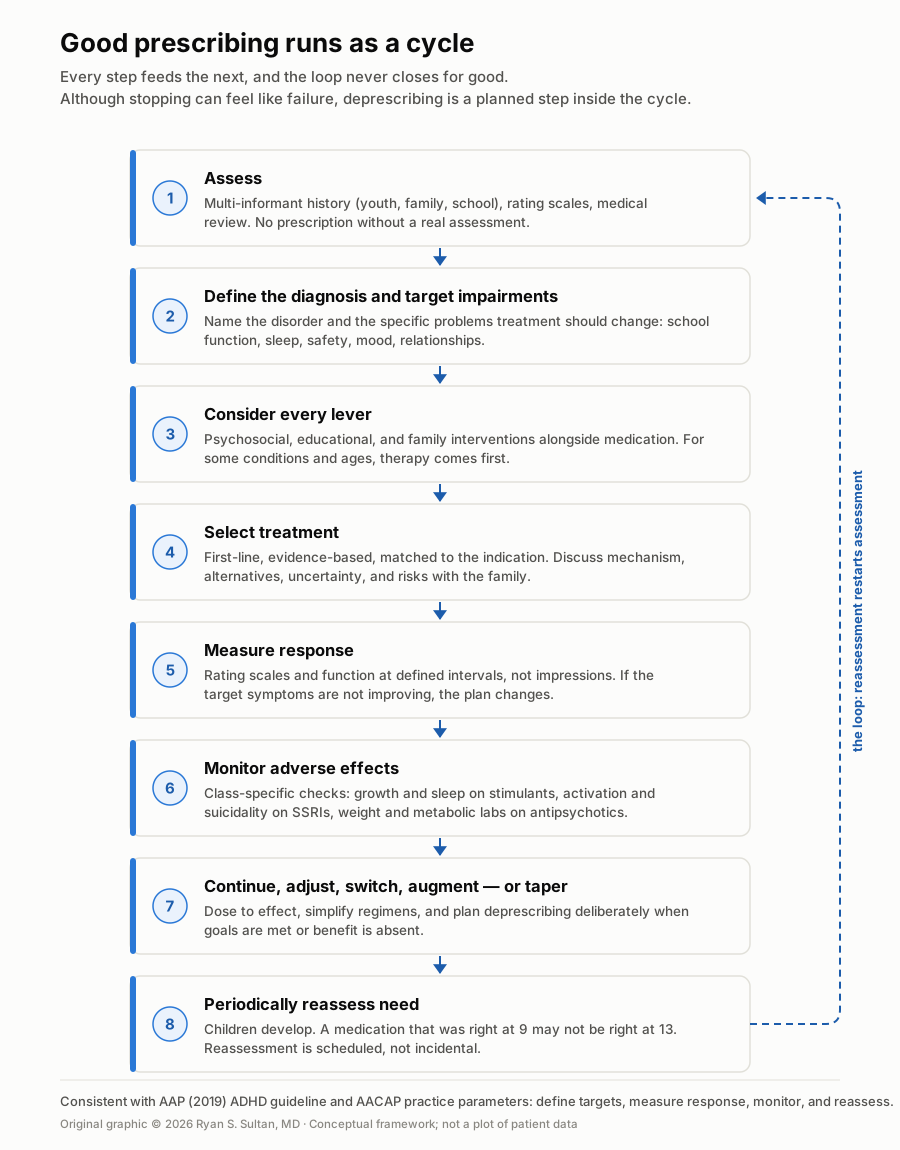
Stopping at the Moment of Remission Roughly Doubles the Relapse Risk
One randomized trial anchors the stop decision for antidepressants, and every parent should know it. Emslie and colleagues took children and adolescents ages 7 to 18 whose depression had remitted on fluoxetine and randomized them: half continued the medication, half were switched to placebo. Over the next six months, 69.2% of the placebo group relapsed. In the continuation group, 42.0% did (Emslie et al., 2008; 102 youth randomized; trial run in the early-to-mid 2000s). That's a number needed to treat of about 4. Continue four kids past remission and you prevent one relapse.
"She's doing well, let's stop" is the most common request I hear, and the Emslie numbers explain the problem with it. Doing well is frequently the medication working, the way staying dry in a rainstorm is the umbrella working. You don't fold the umbrella because you're dry.
This trial has two limitations worth naming, because it gets overquoted. First, the placebo switch was abrupt, so it tells us nothing about how to taper. Second, 42% relapsed even on continued fluoxetine, so staying on offers only partial protection. Nevertheless, what the trial establishes is narrow and useful: stopping at the moment of remission roughly doubles the six-month relapse risk. The stop decision deserves the same rigor as the start decision. Right now it usually gets less.
What a Planned Discontinuation Actually Contains
Since no guideline exists, here's the structure I use in my own practice. Six elements, each load-bearing: skip one and the attempt loses the safety structure that makes it deprescribing.
1. Sustained remission first. A single good month does not qualify. For depression, the randomized evidence supports continuing at least six months past remission before any stop attempt. A child who just got better is the child most likely to get sick again.
2. A defined observation window. Decide in advance how long you'll watch after the last dose, and what "watching" means: which symptoms, rated by whom, how often. Vague vigilance catches nothing.
3. A taper matched to the drug's half-life. A 2025 systematic review of 13 randomized pediatric antidepressant trials, 3,026 patients, found withdrawal symptoms (dizziness, irritability, nausea, insomnia, paresthesia) track the drug's pharmacokinetics: short-half-life agents produce the worst withdrawal, while fluoxetine's long half-life means it effectively self-tapers (Stimpfl et al., 2025, literature through 2024). Critically, the same review names the failure mode I watch for hardest: withdrawal misread as relapse, which gets a child restarted on a medication they may no longer need. Withdrawal arrives within days of a dose cut and fades in one to two weeks. Relapse builds over weeks and looks like the original illness.
4. A relapse plan agreed in advance. Which specific symptoms trigger a call. Who calls whom. What the restart threshold is. Negotiating this during a crisis is too late; negotiate it while everyone is well.
5. Timing in a low-stress window. Never before finals. Never during a family move, a parental divorce, or the first semester of a new school. The taper should land in the flattest stretch of the child's calendar you can find. Summer often works. October rarely does.
6. Scheduled follow-up. Put visits on the calendar during the taper and after it ends; "call if something comes up" catches relapse too late. The Emslie data say relapse risk runs for months, so the follow-up has to run at least that long.
The Rules Change by Class
Antidepressants: the taper follows the half-life
Everything above applies most directly here. The practical points: sertraline and other short-half-life SSRIs need a slow, stepped taper; fluoxetine is far more forgiving because it tapers itself. Expect the withdrawal-versus-relapse question to come up and know the timing rule before it does. And respect the Emslie numbers: this is the one class where a randomized trial has priced the cost of stopping too early.
Stimulants: the one class you can actually test
Stimulants are pharmacologically unusual: they work within hours and wash out within a day or two. That makes a supervised pause a real diagnostic test. Off medication, ADHD symptoms are visible within days rather than months.
A pause answers a narrow question, though. The AAP's 2019 guideline says to manage ADHD as a chronic condition, like asthma, which means reassessment belongs on the schedule at set intervals; presuming the disorder gone each June has no support in the guideline. The formal evidence review behind the UK's NICE guideline (2018, evidence searched through 2017-2018) found withdrawal of ADHD medication risks symptom exacerbation, though some young people maintained their gains, and located exactly one small randomized trial of drug holidays. One. The popular "summer off" practice is running on almost no evidence in either direction, which is why the pause belongs in the prescriber's hands as a planned experiment. I cover the details, including growth monitoring, on my ADHD drug holidays page, and how doses get adjusted rather than abandoned in the titration guide.
Antipsychotics: the least evidence and the highest stakes
No adequately powered randomized discontinuation trial of antipsychotics in children exists. For the drug class with the heaviest side-effect burden in pediatric psychiatry, we have never properly tested how to stop.
The stakes are metabolic and they're documented. In the SATIETY cohort (2001-2007), antipsychotic-naive youth gained 4.4 to 8.5 kg in roughly 11 weeks depending on the agent, versus 0.2 kg untreated (Correll et al., 2009). And these prescriptions run long: in Kentucky Medicaid data from 2012-2017, preschoolers started on an antipsychotic stayed on it for an average of 2.6 years, and 27% for more than four. That combination, real ongoing harm plus no exit protocol, is exactly why I treat two questions as mandatory at every antipsychotic visit: whether the original indication is still present, and whether the dose is still needed. When the answer to either is no, the practical approach is to taper slowly, one step at a time, with explicit symptom monitoring between steps, because rebound and relapse can both follow an abrupt stop.
Alpha-2 agonists: taper, never stop cold
Guanfacine and clonidine are blood-pressure medications that found a second life in ADHD. Stopping them abruptly can produce rebound hypertension, a known class effect, which is why their FDA labels instruct a gradual dose reduction. This is the one class where an abrupt stop isn't just a relapse risk but a direct physiologic one. No exceptions, including the teenager who "just stopped taking it." If that's happened, tell the prescriber promptly.
Forced Stops Strip Out Every Safety Element
Everything above describes a planned discontinuation. Most real-world stops carry no plan at all.
The Adderall shortage made this measurable. In national all-payer dispensing data from 2020-2023, children who had been taking Adderall IR before the October 2022 shortage became 1.2 percentage points more likely (95% CI 1.0-1.3) to end up on no stimulant at all, and the discontinuation was concentrated in kids on Medicaid (He and Chua, 2025). No taper, no observation window, no relapse plan. Just an empty pharmacy shelf, hitting the families with the least slack hardest. I wrote about the mechanics in the stimulant shortage post.
The same logic applies to the quieter versions: the insurance denial that lapses a refill, the parent who stops the medication unilaterally after reading something alarming, the sixteen-year-old who's been spitting out the sertraline for a month without telling anyone. Each one is a discontinuation with every safety element stripped out. If any of these is happening in your house, convert the abandoned stop into a planned one: call the prescriber, say what actually happened, and build the structure around it.
Four Situations Where the Right Call Is to Wait
Four situations where I'll argue against a stop attempt, even when the family wants one:
- Remission is recent. Inside six months of getting well is the highest-relapse window the randomized data have identified. Wait.
- A high-stakes period is coming. Finals, college applications, a school change, a family disruption. Run the taper through the calmest stretch the calendar offers.
- A prior stop attempt ended in relapse. That history is data. Another attempt stays on the table, but the bar rises and the taper slows.
- Symptoms are active. "It's not working perfectly" is a reason to adjust, switch, or augment; treating it as a reason to stop is how kids end up untreated and worse.
One more thing I won't do: stop a medication just to prove the child still needs it. Reassessment is legitimate and the AAP requires it. A loyalty-test discontinuation skips every element above, and the relapse numbers are the price of getting that wrong.
What to Ask the Prescriber Before Any Stop Attempt
If you're considering stopping your child's medication, bring these questions to the appointment. A prescriber who welcomes them is doing the job well.
| Ask | Why it matters |
| What did this medication treat, and how will we know if it comes back? | Names the target and the relapse signal before the taper starts. |
| How long has my child been in remission? | Under six months for depression means the randomized data say wait. |
| What's the taper schedule, and how does this drug's half-life shape it? | Short-half-life agents need slower, stepped reductions. "Just stop it" is a red flag for most classes. |
| How do we tell withdrawal from relapse? | Days-and-fading is withdrawal; weeks-and-building is relapse. Misreading this restarts medications unnecessarily. |
| What's our relapse plan, specifically? | Which symptoms trigger a call, who calls, and what restarts the medication. Agree on it while everyone is well; a crisis is too late. |
| When are the follow-up visits during and after the taper? | Visits go on the calendar before the taper starts. Relapse risk runs for months after the last dose. |
| Is this the right season? | Tapers belong in low-stress windows. Never before finals. |
Frequently Asked Questions
Is it safe to stop my child's antidepressant once they feel better?
Feeling better is exactly when stopping is most dangerous. In the only randomized discontinuation trial of its kind, children and teens ages 7 to 18 who had reached remission on fluoxetine were randomized to continue or switch to placebo. Over six months, 69.2% relapsed on placebo versus 42.0% who continued (Emslie 2008). Doing well often means the medication is working, the way staying dry means the umbrella is working. Most clinicians want at least six to twelve months of sustained remission before attempting a planned taper, and the attempt needs a relapse plan agreed in advance. Never stop without the prescriber.
Why are there no guidelines for stopping psychiatric medication in children?
Because the field never built them. A 2026 systematic review screened 1,390 records published between 2015 and 2025 across five databases and grey literature and found zero formal clinical practice guidelines for stopping psychotropic medications in young people (Fargier 2026). A 2025 scoping review found all 46 published deprescribing curricula in medicine target older adults; none address children (Chow 2025, literature through 2024). The word "deprescribing" appears zero times in the ACGME program requirements for pediatrics, psychiatry, and child and adolescent psychiatry. Starting has guidelines for every class. Stopping has none.
Can my child take a break from ADHD medication to see if it's still needed?
Sometimes, and stimulants are the one class where a supervised pause gives a fast answer, because symptoms return within days rather than weeks. But the 2019 American Academy of Pediatrics guideline says ADHD should be managed as a chronic condition, which means reassessment gets scheduled at set intervals. The NICE evidence review (2018) found that withdrawing ADHD medication risks symptom exacerbation, though some young people maintained their gains, and only one small randomized trial of drug holidays exists. So a pause is a legitimate clinical test when the prescriber plans it, and a poor default when nobody does. See ADHD drug holidays for specifics.
How do I tell withdrawal symptoms from relapse in my child?
Timing and character. A 2025 systematic review of 13 randomized pediatric antidepressant trials covering 3,026 patients found withdrawal symptoms like dizziness, irritability, nausea, insomnia, and paresthesia appear within days of a dose decrease and fade over one to two weeks; they're worst with short-half-life agents, while fluoxetine's long half-life effectively self-tapers (Stimpfl 2025). Relapse builds over weeks and looks like the original illness. The distinction matters because withdrawal misread as relapse gets a child restarted on a medication they may no longer need. If symptoms appear right after a taper step, call the prescriber before concluding the illness is back.
Primary Reference
|
The zero-guidelines finding: Fargier PB, Horowitz M, Charles R, Rousselon V, Fakra E, Beyens MN, Laroche ML. Deprescription of Psychotropics in Children and Adolescents: Systematic Review of Guidelines and Development of a Deprescribing Algorithm. Basic Clin Pharmacol Toxicol. 2026;139(3):e70278. PubMed PMID 42496669 The relapse-risk anchor: Emslie GJ, Kennard BD, Mayes TL, et al. Fluoxetine versus placebo in preventing relapse of major depression in children and adolescents. Am J Psychiatry. 2008;165(4):459-467. PubMed PMID 18281410 The taper science: Stimpfl JN, Walkup JT, Robb AS, et al. Deprescribing Antidepressants in Children and Adolescents: A Systematic Review of Discontinuation Approaches, Cross-Titration, and Withdrawal Symptoms. J Child Adolesc Psychopharmacol. 2025;35(1). PubMed PMID 39469761 The training gap: Chow BJ, Yuzwenko AM, Dennett L, Sadowski CA. Education about deprescribing for pre-licensed and licensed healthcare professionals: A scoping review. Br J Clin Pharmacol. 2025;91(6):1649-1659. Free full text (PMC) Additional reading: NICE NG87 evidence review on ADHD medication withdrawal and drug holidays | AAP 2019 ADHD Clinical Practice Guideline | Dr. Sultan's Publications |
|
Medical disclaimer: This article is educational and is not medical advice. Do not stop, start, or change your child's psychiatric medication based on anything you read here, or anywhere online, without talking to the prescribing clinician. Abruptly stopping some of these medications carries direct physical risk, and stopping others carries substantial relapse risk. If your child is in crisis or you're worried about their safety, call or text 988 (Suicide & Crisis Lifeline) or go to the nearest emergency room. |
Further Reading
- Which Kids Are Overmedicated? What Prescribing Data Show — Companion piece. What national prescribing data from 2006-2023 actually show about volume and appropriateness.
- Psychiatric Deprescribing in 2026: The Sequencing Problem: why the order drugs go in should set the order they come off.
- The 2025-2026 ADHD Stimulant Shortage — What a forced, unplanned discontinuation looks like at national scale.
- ADHD Drug Holidays — When a planned pause is clinically appropriate and when it isn't.
- ADHD Medication Titration — How doses get adjusted deliberately, the mirror image of tapering.
- ADHD Medication Monitoring: What Should Be Checked, and How Often — You can't make a rational stop decision about a medication nobody measured.
- ADHD Medication Side Effects — The adverse-effect profiles that drive many stop conversations.
- Pediatric Antipsychotic Overuse — The class where the stop-question matters most.
- Is ADHD Overdiagnosed and Overmedicated? — Three decades of prescribing trend data.
- Non-Stimulant ADHD Medications — Including the alpha-2 agonists discussed above.
- ADHD Medications Overview — Class-by-class review of approved agents.
- Child Psychiatrist NYC — Evaluation and medication management for children and adolescents.
- Complete ADHD Guide — Diagnosis, treatment, and lifespan management.
- Dr. Sultan's Publications — Peer-reviewed research with free PDF downloads.
Work With Dr. Sultan
Dr. Ryan S. Sultan, MD evaluates and treats children, adolescents, and adults at Integrative Psych in Chelsea, Manhattan. Consultations cover initial diagnostic evaluation, second opinions on complex cases, medication optimization, and planned medication discontinuation with structured follow-up.
What sets Dr. Sultan's practice apart: Double board certification in Adult Psychiatry and Child & Adolescent Psychiatry. NIH NIDA-funded research at Columbia (NIDA K12, 2021–2026). Director of the Sultan Lab for Mental Health Informatics. Author of the 2019 JAMA Network Open study that changed how youth ADHD is prescribed.