Home → Blog → Psychiatric Deprescribing in 2026: The Sequencing Problem
|
Psychiatric deprescribing became federal policy in 2026: an ASCP consensus statement in February, an HHS action plan to "curb psychiatric overprescribing" in May. Our national data on 187,563 young people newly diagnosed with ADHD (2010-2015) point to a more precise target than volume. Among those started on an antipsychotic, 47.9% had never filled a stimulant and only 8.4% had tried both stimulant classes first. The fixable failure is order: the riskier drug going in before the safer, better-studied one. Deprescribing well means running that sequence in reverse. |
Psychiatric Deprescribing in 2026: The Sequencing Problem
By Ryan S. Sultan, MD
Assistant Professor of Clinical Psychiatry, Columbia University Irving Medical Center
Double Board-Certified in Adult Psychiatry & Child/Adolescent Psychiatry
Published:
|
In the news: I was interviewed for De-prescribing psychiatric medicines: A delicate balance by Bridget Balch, AAMCNews, September 15, 2026, alongside Jonathan Alpert (Albert Einstein College of Medicine), Anita Clayton (University of Virginia), and Robert Trestman (Virginia Tech Carilion). This page expands the argument I made there. |
Deprescribing Went From a Geriatrics Term to Federal Policy in Seven Months
The word "deprescribing" was coined in 2003 for older adults on too many pills. In 2026 it arrived in psychiatry all at once. The American Society of Clinical Psychopharmacology released a consensus statement on deprescribing psychotropic medications in February. In May, the Department of Health and Human Services announced an action plan to "curb psychiatric overprescribing," and a federal panel met in July to discuss guidelines on deprescribing and non-medication treatment (as reported by AAMCNews, September 2026). The American Psychiatric Association answered that it supports better prescribing but objects to framing the mental health crisis as primarily a problem of overprescribing.
Both sides are arguing about how many prescriptions get written. The data I've spent a decade on point at a narrower variable that does more harm to children: which prescription comes first.
When AAMCNews asked me about this, here's how I put it:
"What we were seeing is children receiving a more dangerous medication before a less dangerous one. That is a sequencing problem, and I think it is the more useful way to frame this. The question is rarely medication or no medication. It is whether we worked through the safer, better-studied options first, and often we did not."
Half the Children Started on Antipsychotics for ADHD Had Never Tried a Stimulant
In 2019, my colleagues and I published a national cohort in JAMA Network Open: 187,563 commercially insured children, adolescents, and young adults ages 3 to 24 with a new ADHD diagnosis, followed through claims data from 2010 to 2015 (Sultan, Wang, Crystal, Olfson, 2019). We excluded anyone who already had a diagnosis for which antipsychotics carry an FDA indication, such as schizophrenia, bipolar disorder, autism, or Tourette disorder.
Within a year, 2.6% started an antipsychotic. Preschoolers ages 3 to 5 had the highest rate, 4.3%. Then we asked what had been tried first:
| Stimulant history before the first antipsychotic | Share of antipsychotic starters |
| No stimulant prescription at all | 47.9% |
| One stimulant class only (methylphenidate or amphetamine) | 43.8% |
| Both stimulant classes | 8.4% |
Stimulants are the first-line treatment for ADHD, with decades of trial data and an effect size that few drugs in psychiatry match. Antipsychotics carry real metabolic weight in children: in the SATIETY cohort (2001-2007), antipsychotic-naive youth gained 4.4 to 8.5 kg in about 11 weeks depending on the agent, against 0.2 kg in untreated youth (Correll et al., 2009). Even under a generous definition of a defensible reason, 47.3% of the antipsychotic starters in our cohort had no FDA-approved or evidence-supported diagnosis during the follow-up year.
Two limits keep this honest. These were commercially insured families from 2010 to 2015, so the numbers don't describe Medicaid or today's prescribing. And claims data can't see uncoded aggression, which is sometimes the real reason a clinician reached for risperidone. Neither limit changes the order problem. A child with severe aggression and untreated ADHD still deserves an adequate stimulant trial before a drug that can add several kilograms in a season.
Volume Is a Poor Proxy for Harm
If the federal plan treats total prescriptions as the thing to shrink, it will miss where the harm sits. National all-payer dispensing data from 2006 to 2023 show stimulant use among children ages 3 to 17 has been essentially flat since its 2011 peak, and antipsychotic use in that age group fell slightly, from 1.3% to 1.1% (ASPE, 2025). Neither trend looks like a runaway. What does look like a failure is follow-through: among children with at least two antipsychotic prescriptions in 2023, the median state tested both glucose and cholesterol in 35.2% of them (CMS Child Core Set, FFY2024).
So the pediatric picture has three layers. Many children with ADHD and depression still go untreated. A smaller group gets a riskier drug before the standard one. And the children on the riskiest drugs are rarely monitored for the side effects that matter. A policy aimed at the total count fixes none of the three and could make the first one worse.
There is precedent for targeting order directly. When Washington State's Medicaid program required peer review before antipsychotics for young children, use in that group fell by roughly 38% relative to comparison states (Akincigil et al., 2020; data 2006-2011). That policy didn't cap prescriptions. It asked for a second look at a specific decision.
Short Visits and Cheap Generics Push Toward the Prescription Pad
Sequencing fails for structural reasons more than bad judgment. Here's what I told AAMCNews:
"We live in a health care system that pressures physicians to have these short visits with people. People are coming in and they want help. The fastest way to help is to write a prescription."
A month of a generic stimulant can cost less than one therapy session, and a course of therapy runs many sessions (per AAMCNews, therapy averages roughly $100 to $250 a session out of pocket, typically for 12 to 20 sessions). Parent training for a child with ADHD is a real, moderately effective 15-week program. For a family already stretched by two jobs and three kids, it often isn't feasible without medication alongside it.
That's why I push back on the either-or version of this debate. I once treated a child in the emergency department who had jumped off a roof after stopping his ADHD medication. In that case, as I told the reporter, "the right answer is a combined treatment. Not medication alone and not behavioral treatment alone." The useful question is the one that follows: what's the minimum amount of medication that does the job?
Good Deprescribing Runs the Sequence Backward
The ASCP consensus statement asks clinicians to review medication lists regularly for adherence, effectiveness, tolerability, interactions, redundancy, and relapse risk. That's the right checklist. In children, though, the evidence base for stopping is nearly empty: a 2026 systematic review screened 1,390 records from 2015 to 2025 and found zero formal guidelines for deprescribing psychotropics in young people (Fargier et al., 2026). I walk through what a planned taper contains in how to stop a child's psychiatric medication safely.
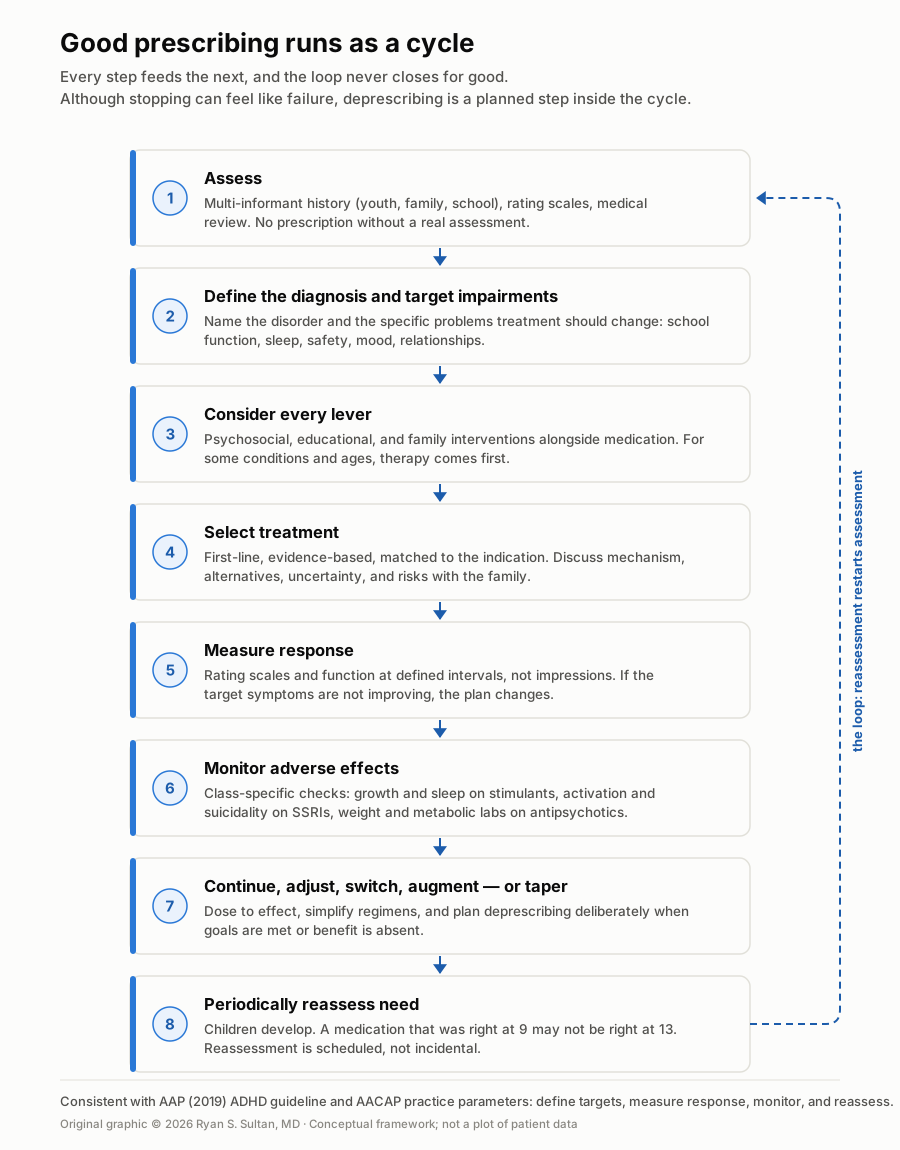
Sequencing gives the review a structure. If medications should go in from safest to riskiest, they should come off in the opposite order, riskiest first, once the indication is gone. In practice, for a child with ADHD on a stimulant plus an antipsychotic, that looks like this:
- Ask what the antipsychotic was for. If there's no FDA-approved or evidence-supported indication in the chart, it's the first candidate to taper.
- Check whether the stimulant trial was ever adequate. One class at a low dose isn't a trial. Optimizing the first-line drug often makes the second drug unnecessary. See the titration guide.
- Get the metabolic labs before deciding. Weight, glucose, and lipids turn the risk side of the conversation from abstract to specific. See what should be monitored.
- Taper one drug at a time, slowly. Change two things at once and you can't tell which one mattered.
- Keep the drug that's working. Deprescribing a stimulant that has a child functioning at school is a different decision from removing an antipsychotic with no indication, and the two shouldn't be bundled.
What to Ask If Your Child Takes More Than One Psychiatric Medication
| Ask | Why it matters |
| What was each medication started for, and is that still present? | Every drug needs a current reason. The reason from three years ago may be gone. |
| Was a stimulant tried at an adequate dose, and were both classes tried? | In our data only 8.4% of antipsychotic starters had tried both. |
| When were weight, glucose, and cholesterol last checked? | The median state checks both labs in about a third of children on antipsychotics. |
| If we reduce something, which goes first and why? | The answer should follow risk: highest-risk, weakest-indication drug first. |
| What will tell us it's going wrong? | Agree on the specific relapse signals before any dose changes. |
Frequently Asked Questions
What is psychiatric deprescribing?
Deprescribing is the planned, supervised reduction or stopping of a medication that is no longer needed, no longer working, or causing harm that outweighs its benefit. The term came from geriatrics in 2003. In 2026 the American Society of Clinical Psychopharmacology issued a consensus statement on applying it to psychotropic medications, and HHS announced a federal action plan on psychiatric prescribing.
Are children overprescribed psychiatric medication?
The national data don't support a simple yes. Stimulant use in children ages 3 to 17 has been flat since 2011 and antipsychotic use fell slightly from 2006 to 2023. The clearest documented problem is order: in our study of 187,563 young people with new ADHD diagnoses (2010-2015), 47.9% of those started on an antipsychotic had never filled a stimulant. Many other children with ADHD and depression go untreated.
Should antipsychotics be used for ADHD?
Antipsychotics are not approved for ADHD. They sometimes have a role for severe aggression that persists after adequate stimulant treatment, and risperidone has trial evidence in that setting. An adequate trial generally means both stimulant classes, methylphenidate and amphetamine, at therapeutic doses. In our data only 8.4% of youth started on antipsychotics had tried both first.
Can my child stop an antipsychotic?
Often, when the original reason is gone, but never abruptly and never without the prescriber. Antipsychotics should be tapered gradually with symptom monitoring between steps, because rebound and relapse can both follow a sudden stop. Bring the questions above to the next appointment.
Primary References
|
The sequencing study: Sultan RS, Wang S, Crystal S, Olfson M. Antipsychotic Treatment Among Youths With Attention-Deficit/Hyperactivity Disorder. JAMA Netw Open. 2019;2(7):e197850. Free full text · PubMed PMID 31348506 The news coverage: Balch B. De-prescribing psychiatric medicines: A delicate balance. AAMCNews. September 15, 2026. aamc.org The zero-guidelines finding: Fargier PB, Horowitz M, Charles R, et al. Deprescription of Psychotropics in Children and Adolescents: Systematic Review of Guidelines and Development of a Deprescribing Algorithm. Basic Clin Pharmacol Toxicol. 2026;139(3):e70278. PubMed PMID 42496669 Additional reading: full breakdown of the 2019 antipsychotic study | youth psychiatric medication statistics, sourced | Dr. Sultan's publications |
|
Medical disclaimer: This article is educational and is not medical advice. Do not stop, start, or change your or your child's psychiatric medication based on anything you read here without talking to the prescribing clinician. Stopping some of these medications abruptly carries direct physical risk, and stopping others carries relapse risk. If you or your child is in crisis, call or text 988 (Suicide & Crisis Lifeline) or go to the nearest emergency room. |
Further Reading
- Which Kids Are Overmedicated? What Prescribing Data Show: the national volume data, 2006-2023.
- How to Stop a Child's Psychiatric Medication Safely: the six elements of a planned taper.
- Pediatric Antipsychotic Overuse: every number from the 2019 study.
- Pediatric Psychotropic Prescribing: U.S. national patterns by class and age.
- Is ADHD Overdiagnosed and Overmedicated?: three decades of trend data.
- ADHD Medications Overview: the first-line options, class by class.
- Psychiatric Medication Management in NYC: medication reviews and second opinions.
- Press: interviews and media resources.
Work With Dr. Sultan
Dr. Ryan S. Sultan, MD evaluates and treats children, adolescents, and adults at Integrative Psych in Chelsea, Manhattan. Medication reviews for children on more than one psychiatric medication, second opinions, and planned discontinuation with structured follow-up.